OF OCCUPATION AND RESISTANCE by FAHAD SHAH
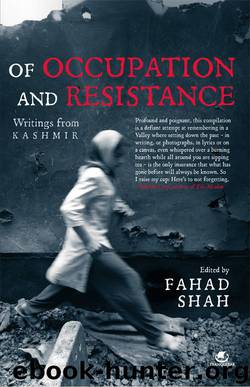
Author:FAHAD SHAH [SHAH, FAHAD]
Language: eng
Format: epub
ISBN: 9789383260010
Published: 2014-07-05T00:00:00+00:00
————————
1 See also: Kazi, Seema, ‘Kashmir: Cri de Coeur’, in Open Democracy, 16 July 2010 <http://www.opendemocracy.net/seema-kazi/kashmir-cri-de-coeur> [accessed 17 March 2013].
‘Love is Strong as Death’: The Moral Voice of the Kashmiri Tehreek
Shubh Mathur
‘Love is strong as death.’ I first came across these words in 1986, the year I came to the US as a graduate student. Amid all that was new and unfamiliar, these words, seen in passing on a monument in Providence, Rhode Island, as in a dream, remained clearly etched in memory as dreams will, urgent and compelling. I have been trying to understand them ever since. A series of crises, personal and collective (neither kind in short supply for an Indian), gave me a glimmer of understanding of the power of love and kindness to transcend death, cruelty, pain in their many forms. The words I read in Providence came back to me as I tried to understand the lives and what we call the activism of the families of the disappeared in Kashmir.
Despite 22 years of documentation and analysis, no one has been able to find a pattern in the disappearances. There is no demographic, geographic or social logic to who is arrested, who is released after torture, and who joins the ranks of the disappeared. The sole purpose and logic behind the disappearances is to create terror among the civilian population, to enact the random and absolute power of the armed forces, to break down popular support for the movement for independence. In this continuing chronicle of military terror, the families of the disappeared oppose a profoundly moral voice. Grief and love give the families the courage to confront and challenge this regime. Their very vulnerability, juxtaposed against the power of the army, casts into sharp focus its immorality and illegitimacy.
It becomes clear that words like ‘activism’ and ‘advocacy’, with their roots in Western liberal theory and the underlying idea of rational choice in political action, are completely inadequate for describing the compulsions of those living in a situation of political repression and military terror.1 One does not choose to search for a missing son or father – it is impossible to do otherwise. Family narratives illustrate the financial, physical and psychic costs of the search; the struggle to survive economically when a father, son or husband is taken away competes for primacy with the search. Families travel to prisons far from Kashmir where Kashmiri prisoners are held, to Indian cities and to the infamous Tihar jail in Delhi. They seek news from the army camps, from seers, from shrines and dreams. Children whose fathers have been disappeared grow up in orphanages when the mothers and families can no longer provide for them.
And yet, whether it has been 2 years since the disappearance or 20, it is impossible for the families to give up the search. They have become a symbol for the sorrow, suffering and endurance of the Kashmiri people under two decades of Indian army rule.
Download
This site does not store any files on its server. We only index and link to content provided by other sites. Please contact the content providers to delete copyright contents if any and email us, we'll remove relevant links or contents immediately.
| Elections & Political Process | Ideologies & Doctrines |
| International & World Politics | Political Science |
| Public Affairs & Policy | Specific Topics |
| United States |
The Secret History by Donna Tartt(19032)
The Social Justice Warrior Handbook by Lisa De Pasquale(12183)
Thirteen Reasons Why by Jay Asher(8884)
This Is How You Lose Her by Junot Diaz(6872)
Weapons of Math Destruction by Cathy O'Neil(6261)
Zero to One by Peter Thiel(5782)
Beartown by Fredrik Backman(5734)
The Myth of the Strong Leader by Archie Brown(5491)
The Fire Next Time by James Baldwin(5424)
How Democracies Die by Steven Levitsky & Daniel Ziblatt(5211)
Promise Me, Dad by Joe Biden(5141)
Stone's Rules by Roger Stone(5079)
A Higher Loyalty: Truth, Lies, and Leadership by James Comey(4946)
100 Deadly Skills by Clint Emerson(4911)
Rise and Kill First by Ronen Bergman(4776)
Secrecy World by Jake Bernstein(4738)
The David Icke Guide to the Global Conspiracy (and how to end it) by David Icke(4697)
The Farm by Tom Rob Smith(4500)
The Doomsday Machine by Daniel Ellsberg(4481)
